Archive review recorded: September 16, 2026 · official source panel included below
November 2026 Policy Update: New Data Sync and Compliance Mandates for the Vietnam UD1 Visa
Review September data-sharing and electronic-identity changes, Apostille scope, and the compliance checks that UD1 applicants and sponsors should confirm.
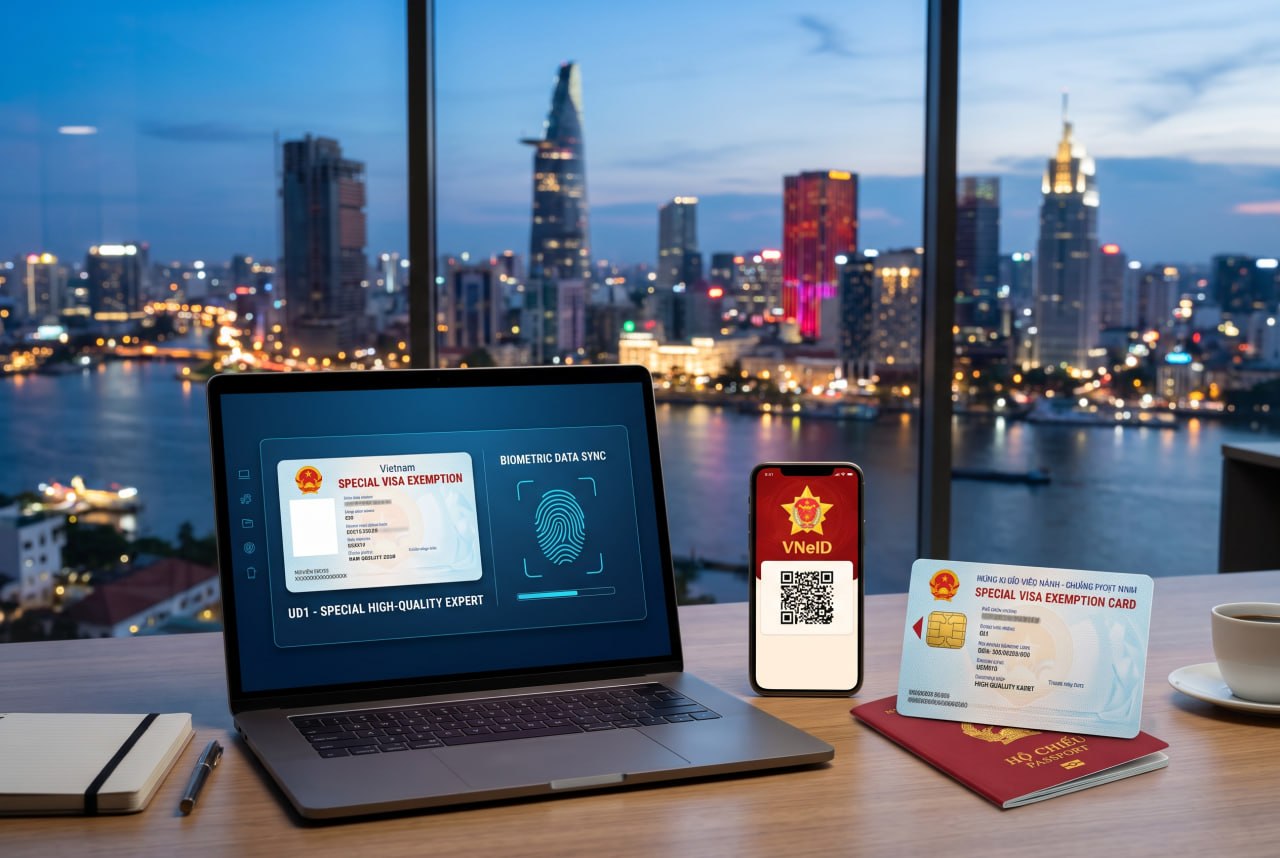
Illustration of immigration data, VNeID and conceptual cards in Ho Chi Minh City, not official documents or app screens.
Direct answer
What this article answers
November 2026 Vietnam UD1 update: Decrees 286 and 320, VNeID account scope, Apostille checks, and practical sponsor compliance with official sources.
Frequently asked questions
- Are Vietnam UD1 and the Special Visa Exemption Card the same route?
- No. UĐ1 is an immigration category under Law 118/2025/QH15. The special visa-exemption card under Decree 221/2025/NĐ-CP has a separate legal basis and process. An SVEC is not automatically issued alongside a UD1 visa.
- Does Decree 320 require every UD1 holder to register for VNeID?
- The reviewed Decree 320 explanation does not establish a blanket UD1/SVEC registration mandate. Lawful foreign entrants or residents can request electronic-identification accounts without level classification. Confirm any identity requirement for the particular online service being used.
- Does Decree 286 automatically reject every address mismatch?
- The official explanation provides for inter-agency data exchange and residence-management coordination. It does not establish a universal automatic mismatch-rejection system. Keep identity, sponsor and accommodation records accurate, and confirm how corrections must be reported.
- Can an Apostille replace consular legalization for a UD1 document?
- It can for a covered public document where the Convention applies between the issuing state and Vietnam. Confirm document scope, the country relationship, translation and receiving-authority requirements. An Apostille does not establish UD1 eligibility or acceptance of the document contents.
- Is a seven-day health declaration required for every traveler to Vietnam?
- No universal requirement is established by the reviewed Government clarification. The Ministry of Health says declarations are not mandatory on a routine basis for every traveler. Confirm any activated health instruction and the current pre-arrival requirements for the actual trip.
Article source review: November 8, 2026. The effective dates below are September dates, not new November commencement dates.
For STEM experts, corporate executives, and their sponsoring entities, Vietnam UD1 planning requires attention to both the qualifying legal route and the accuracy of immigration records. This fall's data-coordination, electronic-identification, and document-authentication changes affect preparation, but they do not replace the route-specific eligibility test.
UD1 and the Special Visa Exemption Card (SVEC) are separate legal routes. Law No. 118/2025/QH15 provides the UD1/UD2 framework, while Decree No. 221/2025/NĐ-CP governs the special visa-exemption route. An SVEC is not automatically issued alongside a UD1 visa.
Here are the legal changes and practical checks to review as we close out 2026.
1. Decree 286: Real-Time Cross-Agency Data Synchronization
Effective date: September 15, 2026.
Decree No. 286/2026/NĐ-CP establishes a coordination mechanism for managing foreigners' entry, exit, transit, and residence. Government News describes regular and real-time exchange of immigration, visa, temporary-residence, and security information between the Ministry of Public Security, Ministry of Foreign Affairs, Ministry of National Defence, and other authorities.
What this means for UD1 holders: Keep passport details, sponsor filings, and accommodation records accurate and consistent. The decree's coordination framework does not, by itself, establish that every Form NA-02 filing and hotel registration is instantly cross-checked or that every address mismatch creates an automatic system flag or rejection.
Sponsor impact: Relevant authorities must coordinate on residence management. Sponsors and applicants should identify who handles the actual accommodation declaration and confirm how changes are reported. Do not assume that an initial hotel booking can replace reporting the place where the person actually stays. These are preparation checks, not a newly verified rule requiring identical address text across every database.
2. Decree 320: Electronic Identification for Foreign Residents
Effective date: September 28, 2026.
Decree No. 320/2026/NĐ-CP amends Vietnam's electronic-identification and authentication framework. Under the amended Article 7, foreigners who lawfully enter or reside in Vietnam can receive electronic-identification accounts when they need one. Their accounts are not classified by level.
The shift: The Government's published explanation describes expanded account access and the integration of documents into VNeID. It also makes database connectivity a condition of automatic document synchronization. Do not assume that every visa, investment certificate, or practicing licence is already connected.
This is not a blanket requirement for every UD1 holder to register immediately after an SVEC is issued. Account access and any identity-linking obligation for a particular online service are separate questions.
Sponsor impact: Confirm the current account, representative authorization, and filing channel required by the service being used. Do not describe an organization's account as a foreign resident's “Level-2” account or assume that a general June mandate applies to every UD1 sponsorship request.
3. The Apostille Convention Is Now in Force
Entry into force for Vietnam: September 11, 2026.
The HCCH status table records September 11, 2026 as Vietnam's entry-into-force date. For qualifying foreign public documents exchanged between Contracting States where the Convention applies between the two countries, an Apostille can replace diplomatic or consular legalization.
The benefit: Eligible documents may no longer need the same multi-step embassy legalization process. However, this does not mean every diploma, background check, or private corporate appointment letter can be filed with only an Apostille. Check the document's public-document or official-certification status, the issuing authority, any objection affecting the country relationship, translation requirements, and the receiving authority's dossier instructions.
An Apostille authenticates the relevant signature, capacity, and seal or stamp. It does not establish UD1 eligibility or guarantee acceptance of the document's contents.
Action Checklist for UD1 Sponsors and Applicants
- Verify accommodation records. Confirm the actual stay, the responsible accommodation reporter, and the procedure for later address changes.
- Audit identity and arrival data. Reconcile passport numbers, dates of birth, and name spellings across the forms required for the specific trip and filing. A seven-day health declaration is not a universal requirement. Confirm current health instructions and whether a Digital Arrival Card, its timing, and its entry-point coverage apply to the journey.
- Check digital access. Ask the competent authority which sponsor account and representative authorization the current filing service requires. Do not treat a general VNeID update as proof of a UD1-specific filing mandate or an automatic tax/compliance hold.
- Confirm authentication before ordering documents. Check the Apostille country relationship and document category, then confirm translation and dossier requirements with the receiving authority.
Operating at the intersection of Vietnam's digital economy and global talent mobility requires accurate records and route-specific checks. Use the current UD1 guide for the wider legal-update review and the sponsor-readiness checklist for filing preparation. Follow VietnamUD1Visa.com for source-linked UD1 and IFC updates.
Independent information, not legal advice. Residence, work authorization, tax, and document acceptance require separate checks. This article covers the three subjects above, not every legal change in November.
Illustration only: the supplied preview image depicts conceptual card and app screens. It is not an official visa, SVEC specimen, or VNeID interface.
VietnamUD1 Editorial Team
Independent research based on public legal and policy sources. Content is general information, not legal or tax advice.
Related Vietnam UD1 guides
Vietnam UD1 After Filing: Sponsor, Role, Passport, and Address Changes
A post-filing data-consistency checklist for sponsor, role, passport, address, and travel-record changes across Vietnam UD1 cases.
Vietnam UD1 Traveler Declarations: Confirm the Current Pre-Arrival Requirements
Confirm the Digital Arrival Card timing, entry-point instructions, and any additional traveler declaration without relying on an older universal health-declaration summary.
Vietnam UD1 Visa: May 2026 Implementation Readiness Update
A dated briefing on sponsor readiness, document authentication, traveler preparation, and questions that still require current authority confirmation.